I have never felt so moved by Art Nouveau as in the streets of Prague … standing in front of the door of a building where sunflowers bloom. The city dared everything and succeeded at everything, as if by magic. An enchantment! Prague does that to people … at least to those who look beyond the tourist traps in shop windows. Beauty is all around as the whole city seems to be wrapping you in curving lines and figures, until you feel yourself swirling through the space and time. It’s no wonder, then, that the patterns still imprinted on the surface of my retina … bring back memories of Mucha and Sarah Bernhardt when I look at the card of Mismagius.

The character of Mismagius is floating at the center of the card inside a huge circular motif, something between a halo and a rose window, with flowers drooping around her like a wilting bouquet. Her pose itself is curved and echoes the moon’s cycle subtly depicted below. Neither day nor night, the atmosphere is in-between. There is one of those nighttime atmospheres where darkness recedes before the brightness of the full moon (with which she is aligned). The purple, brown, and golden hues also evokes an autumnal weather, drawing parallels to the poetic symbolism of the moon contemplation called Tsukimi. The movement of the dress and the forward-leaning posture give this illustration great depth. It even seems that Mismagius is traveling between two dimensions. Charged with all this dancing and magnetic energy, we cannot help but see a wink to Mucha’s illustrations.

To be convinced of this, one should refer in particular to Mucha’s allegory of dance (rather than to his posters depicting Sarah Bernhardt). La Danse is one of four panels (together with Painting, Poetry and Music) in a decorative series called The Arts. The dancer appears flamboyant with her long red hair and the fabric that swirls around her like petals in the wind. Here, Mucha did not make a portrait of a specific dancer. The anonymous allegory serves a greater purpose than herself by embodying an entire art form. And it is undoubtedly from this allegorical perspective that we must also view Aoki’s card. The setting then becomes more evocative and universal, as it perfectly illustrates the “Psychic Sphere” attack. It becomes its very embodiment.

With Medea, Mucha also touched on mythology and the figure of the sorceress and witch. The halo of sanctity or crime crowns Sarah Bernhardt’s character while simultaneously serving as a setting sun on the horizon… another psychic sphere. Mismagius falls within this same ambiguity between shadow and light. This ties well into the fin-de-siècle fascination with the unknown and paranormal activities such as spirit photographs, ectoplasm sessions, Méliès evoking spirits, or Charcot photographing women mid-“hysterical attack” at the Salpêtrière. About them, the art historian Georges Didi-Huberman has shown that the poses were effectively staged and taught back to patients. Few centuries earlier, a woman would be burnt as a witch, and then she was diagnosed and photographed instead … the cliché of an unruly feminity.


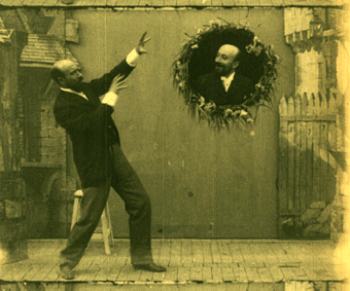


1- Schrenck-Notzing, The medium Stanislawa P. with an ectoplasmic veil, 1923 / 2- Planche XXIII, attitudes passionnelles, extase. Iconographie photographique de la Salpêtrière : service du Dr Charcot, par Désiré Bourneville, Delahaye, Paris, 1878. Bibliothèque municipale de Lyon / 3- From Georges Méliès Summoning the Spirits (Évocation spirite) – 1899 / 4- William Hope – Photograph of an elderly couple with a young female ‘spirit’ – circa1920 – Science Museum Group Collection / 5- William H. Mumler – Picture of Mary Lincoln with the alleged ghost of her husband Abraham Lincoln behind her – circa 1872 – Original CDV held by The Lincoln Financial Foundation Collection, Fort Wayne, IN.
To get back to Mucha, it’s also worth mentioning that he arrived in Paris just as Japonisme was sweeping through the art world and he absorbed it in his own way. So the circle closes as Japanese aesthetics helped shape the look Mucha made famous in Paris, and a century later that same Mucha look found its way back to Japan. The Mucha Foundation even spent the better part of a decade touring a show called Timeless Mucha: The Magic of Line through Japanese museums, explicitly tracing his influence on manga from the 70’s onward.

Maybe, nobody carried that inheritance further than Yoshitaka Amano (which is a slightly unfair thing to say about an artist with his own very distinct watercolors, except that he’s said it about himself). Asked directly about his influences, Amano has named Gustave Moreau, Leonardo da Vinci, and Alphonse Mucha. Still dazzled by Mucha’s compositional work and the androgynous pallor of Amano’s characters, that’s how we come to another Pokémon card that is just as seductive as Mismagius: the N’s Zoroark ex by Mizutani.

Both illustrators on these two cards are worth lingering on for themselves. Aoki is a relatively recent name in the TCG (not to be confused with Toshinao Aoki). Their first credited cards (Frosmoth and Zacian V) only appeared in 2022, in the Japanese VMAX Climax subset. Their style presents a consistent use of soft edges and almost watercolor-diffuse rendering. The figures always seem to be dissolving into the background. Among the the “Art Rare” cards, Aoki is one of the few current Pokémon illustrators actually painting in overlapping translucent layers rather than drawing a figure and filling it in. As to Mizutani, her path to this card is longer and more institutional. She’s been part of the Pokémon design world since the Black and White generation, originally as an in-house character designer at Game Freak responsible for several Gym Leaders and Trainers (including N) before going freelance in 2014. It means that this card isn’t an outside artist’s interpretation of someone else’s character (as she defined how N looks in the first place), but she came back to it with this spectacular illustration.
Neither Aoki nor Mitzutani has ever mentioned Mucha in an interview that I could find. But some lines get into the water supply early enough that you can draw in them without knowing where they came from … which is, among other things, a good description of what it’s like to spend four days walking around Prague and go home seeing haloes and dancing houses.
Bibliography:
Mucha Foundation (n.d.) The Arts: Dance (1898), Poster for ‘Médée” (1898).
Didi-Huberman, G. (2003 [1982]) Invention of Hysteria: Charcot and the Photographic Iconography of the Salpêtrière. Translated by A. Hartz. Cambridge, MA: MIT Press.
Square Enix (2012) Final Fantasy Ultimania, Archive, Volume 1. Milwaukie, OR= Dark Horse Books.