L’exposition David Lynch: Up in Flames, présentée au DOX Centre for Contemporary Art à Prague jusqu’au 8 février 2026, offre une relecture essentielle de l’œuvre de David Lynch (1946 – 2025). Formé à la peinture à la Pennsylvania Academy of the Fine Arts avant de devenir réalisateur, Lynch a toujours conçu son travail comme un continuum entre arts visuels et cinéma. L’exposition, la première du genre en République tchèque, réunit plus de quatre cents œuvres réalisées du milieu des années 1960 jusqu’à sa mort : dessins, lithographies, aquarelles, photographies et courts métrages expérimentaux. Elle rappelle que l’univers de Lynch s’est d’abord élaboré dans la matière picturale… dans la lenteur du geste, l’odeur du pigment, la vibration du support… avant de se déployer dans la lumière mouvante du cinéma.
© The David Lynch Estate, Courtesy Item éditions, Paris
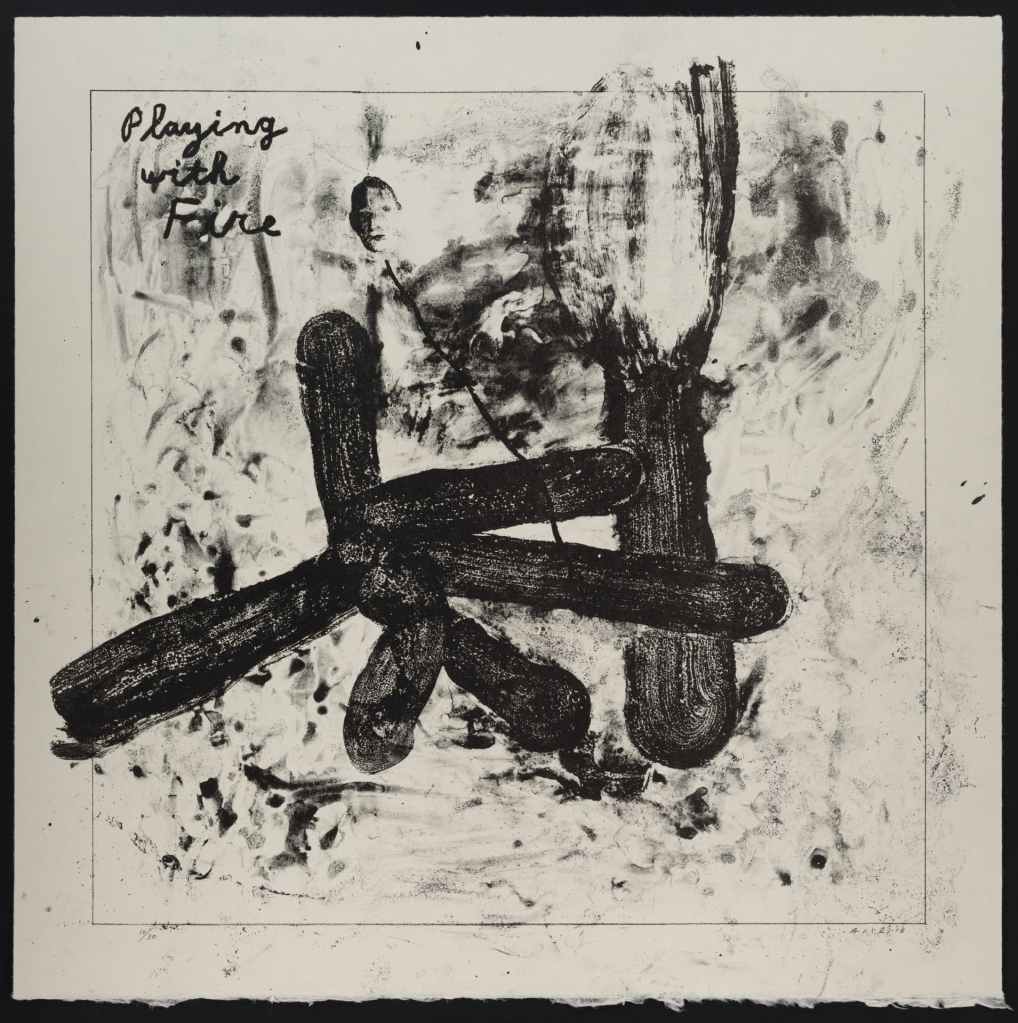
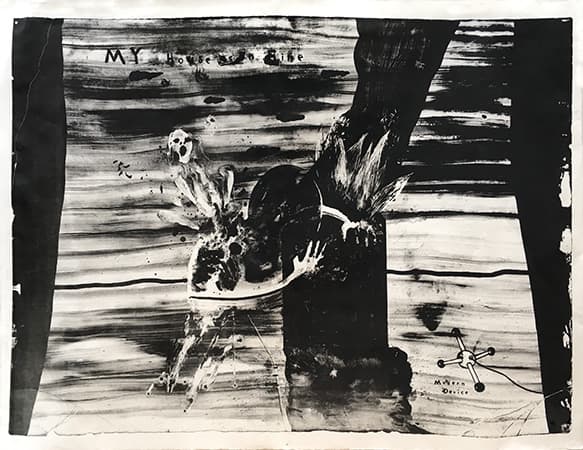
À travers cette traversée chronologique et thématique, Up in Flames dévoile un Lynch plasticien au vocabulaire dense et singulier. Loin de l’image du cinéaste visionnaire enfermé dans ses mythes filmiques, il apparaît ici comme un créateur qui interroge le visible et le corps de l’image. Le titre, Up in Flames (« Partir en flammes »), trouve un écho direct dans ses œuvres picturales où les maisons brûlent, les visages se consument, les formes se dissolvent. Le feu y agit à la fois comme motif et métaphore : il détruit et transfigure, il révèle l’envers du décor. Dans des œuvres comme My House Is on Fire – Modern Device (2013), cette tension entre combustion et révélation devient langage. Le feu est à la fois destruction et illumination ; il incarne la manière dont Lynch fait remonter à la surface les forces inconscientes qui sous-tendent son univers.

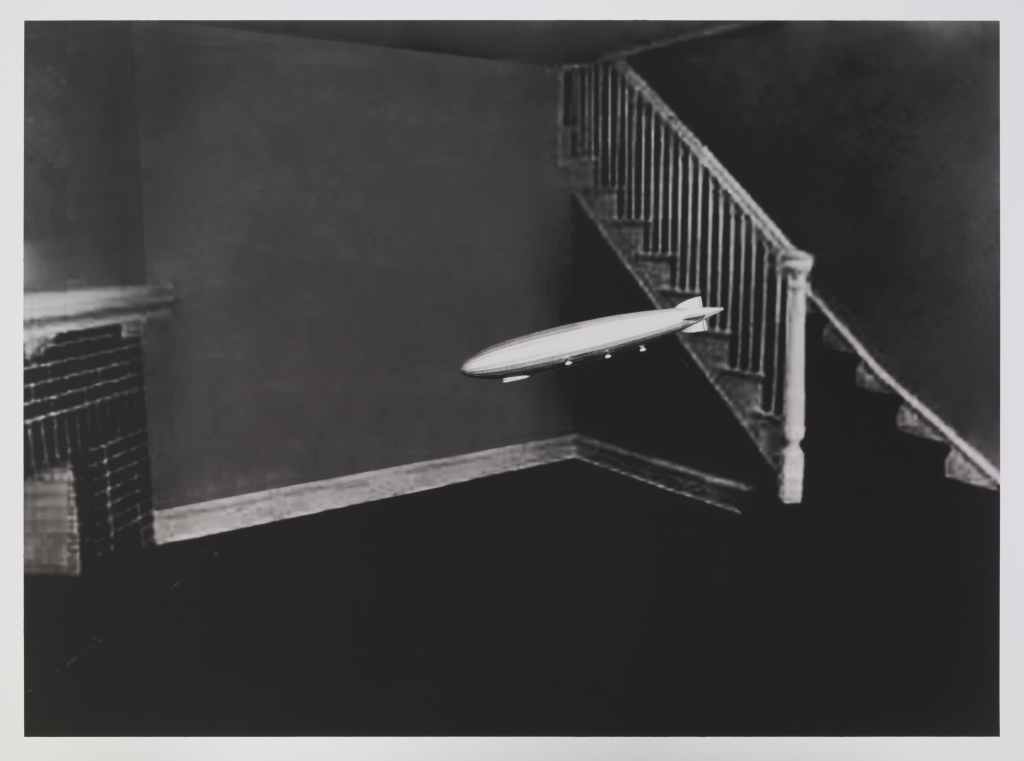
L’exposition souligne aussi combien l’esthétique de Lynch repose sur l’inquiétante étrangeté : ce déplacement infime par lequel le familier devient menaçant. Dans ses dessins comme dans ses films, les visages et les objets oscillent entre l’ordinaire et le cauchemar. L’architecture domestique (chambres, salons, façades) devient un espace instable, un seuil vers un autre monde. Le parcours au DOX traduit visuellement cette expérience du passage. Plutôt qu’une exposition linéaire, Up in Flames juxtapose des zones de silence et d’intensité, des contrastes de lumière et de couleur qui reproduisent le mouvement même de la pensée lynchienne : l’alternance entre la surface lisse du quotidien et la faille qui l’habite.
© The David Lynch Estate, Courtesy Item éditions, Paris
La scénographie, elle aussi, prolonge cette dramaturgie. Les salles du DOX sont traversées de rouges et de gris profonds, évoquant les tonalités emblématiques des films de Lynch et notamment la « Red Room » de Twin Peaks. Ce rouge, omniprésent, agit comme un fil sensoriel : il renvoie au feu du titre, à la passion, au danger, à la limite. Dans une des salles, il devient véritable matière d’immersion, enveloppant les œuvres d’une chaleur presque organique. L’usage de cette couleur n’est pas décoratif : il construit une tension visuelle et psychique, il transforme l’espace d’exposition en un seuil perceptif, une zone intermédiaire entre veille et rêve. L’exposition devient ainsi un espace liminaire, au sens où Lynch les conçoit… ni tout à fait réel, ni tout à fait imaginaire, mais habité par la présence du trouble.
© The David Lynch Estate, Courtesy Item éditions, Paris
À Prague, Up in Flames révèle un artiste total, pour qui l’image n’est jamais un simple objet à contempler mais une expérience à traverser. Les médiums (peinture, gravure, photographie, film) s’y répondent comme des variations d’une même recherche : celle de rendre visible l’invisible, de donner forme à ce qui brûle sous la surface du réel comme de la peau. On retrouve cette même énergie de transformation qui animait toute sa carrière : faire du familier un mystère, du banal un vertige, du silence un cri. L’exposition du DOX ne célèbre donc pas seulement la mémoire d’un créateur disparu, elle restitue la cohérence profonde d’une œuvre qui, de la toile à l’écran comme de l’oeil à l’esprit, n’a cessé d’explorer la frontière fragile entre la lumière et l’obscurité… entre ce qui se consume et ce qui (re)naît dans les flammes.
Plus d’infos :
https://www.dox.cz/en/whats-on/david-lynch-up-in-flames
https://www.instagram.com/doxprague/
ENGLISH VERSION:
David Lynch: Up in Flames – DOX Centre for Contemporary Art à Prague
The exhibition David Lynch: Up in Flames, presented at the DOX Centre for Contemporary Art in Prague until February 8, 2026, offers an essential reinterpretation of the work of David Lynch (1946–2025). Trained in painting at the Pennsylvania Academy of the Fine Arts before becoming a filmmaker, Lynch always conceived of his work as a continuum between visual arts and cinema. The exhibition, the first of its kind in the Czech Republic, brings together more than four hundred works created from the mid-1960s until his death: drawings, lithographs, watercolors, photographs, and experimental short films. It reminds us that Lynch’s universe was first developed in the pictorial material… in the slowness of the gesture, the smell of the pigment, the vibration of the support… before unfolding in the shifting light of cinema.
Through this chronological and thematic journey, Up in Flames reveals a Lynch who is a visual artist with a dense and singular vocabulary. Far from the image of the visionary filmmaker trapped in his cinematic myths, he appears here as a creator who questions the visible and the body of the image. The title, Up in Flames finds a direct echo in his pictorial works where houses burn, faces are consumed, and forms dissolve. Fire acts as both motif and metaphor: it destroys and transfigures, revealing the hidden side of things. In works like My House Is on Fire – Modern Device (2013), this tension between combustion and revelation becomes language. Fire is both destruction and illumination; it embodies the way in which Lynch brings to the surface the unconscious forces that underlie his universe.
The exhibition also highlights how much Lynch’s aesthetic relies on the uncanny: this minute shift by which the familiar becomes stange and threatening. In his drawings as in his films, faces and objects oscillate between the ordinary and the nightmarish. Domestic architecture (bedrooms, living rooms, facades) becomes an unstable space, a threshold to another world. The exhibition at DOX visually translates this experience of transition. Rather than a linear exhibition, Up in Flames juxtaposes areas of silence and intensity, contrasts of light and color that reproduce the very movement of Lynchian thought: the alternation between the smooth surface of everyday life and the flaw that inhabits it.
The set design also extends this dramatic structure. The DOX theaters are bathed in deep reds and grays, evoking the iconic tones of Lynch’s films, particularly the “Red Room” of Twin Peaks. This omnipresent red acts as a sensory thread: it evokes the fire of the title, passion, danger, and the limit. In one of the rooms, it becomes a truly immersive experience, enveloping the artworks in an almost organic warmth. The use of this color is not merely decorative: it constructs a visual and psychological tension, transforming the exhibition space into a perceptual threshold, an intermediate zone between wakefulness and dreaming. The exhibition thus becomes a liminal space, in the sense that Lynch conceives of them… neither entirely real nor entirely imaginary, but inhabited by the presence of unease.
In Prague, Up in Flames reveals a complete artist, for whom the image is never simply an object to contemplate but an experience to be traversed. The mediums (painting, engraving, photography, film) respond to one another like variations on the same quest: to make the invisible visible, to give form to what burns beneath the surface of reality, as if it were skin. We find again this same transformative energy that animated his entire career: to make the familiar a mystery, the banal a vertigo, silence a cry. The DOX exhibition, therefore, does not merely celebrate the memory of a departed creator; it restores the profound coherence of a body of work that, from canvas to screen, from eye to mind, ceaselessly explored the fragile boundary between light and darkness… between what is consumed and what is (re)born in the flames.
More information:
 ABSTRACT MIMESIS