A look back at the exhibition of Tomáš Jetela, curated by Kamil Princ for the (A)void Gallery in Prague. The place is like a landmark, located along the Vltava, with its striking architecture and its large round glass door which pivots on a vertical axis. Are we on earth or underground, inside or outside, dead or alive… space has no limits… except that of the imagination.

Walking along the quays when the golden hour of late summer comes to lick the facades of the city and repaint the canvases like a fleeting kiss from the setting sun… is to experience time… and to grasp the magic of the moment… suspended. Let yourself be surprised and captivated by the place… let yourself be caught in the game of looking through it and, perhaps even pass to the other side of this glass which makes the light and shadows of visitors dance on the ground as well as on the surface of water… See your face… see the city reflected in it. It’s a bubble, a mirror, a porthole, an aquarium… or maybe even a tomb… but of whom if not ourselves? The title also responds well to the architecture and this round opening which is reminiscent of the iconography of the tomb of Christ and the disc-shaped stones which closed tombs in the Second Temple period… Et Resurrexit a Mortuis.
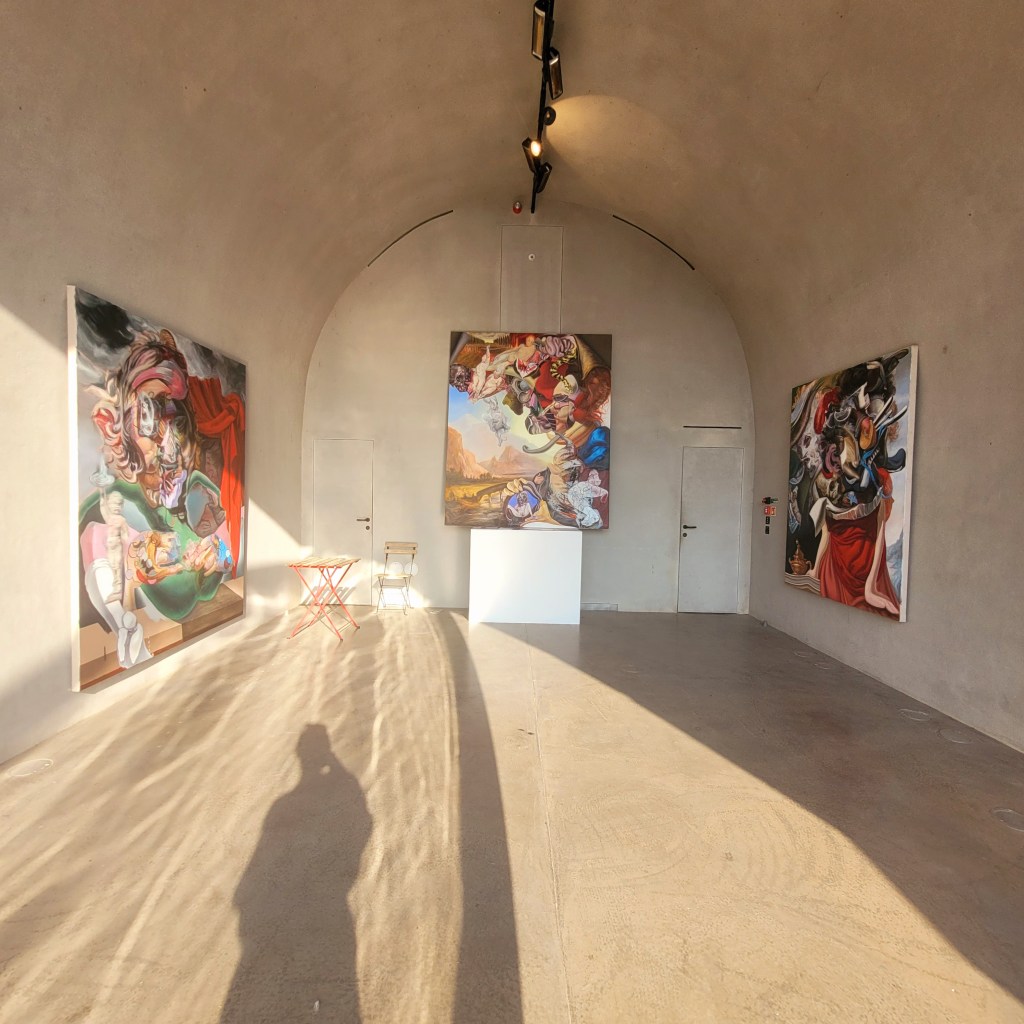

It is therefore a whole symbol that comes to life as the day fades and only the exhibition continues to shine in the darkness. Here, underground, unsuspected by those who walk or circulate above, the exhibition comes to life. Through his works, the artist gives the visitor this part of immortality which is expressed through the emotion of a transformation. By entering, the spectator accepts to die… metaphorically but effectively… in what he was previously… in his routine… his habits… his predictions and his illusions. By entering, he also agrees to live again… as a new man… enriched with new perspectives and a new consciousness… of the world and of himself. It’s a shock… a disruption… a fall (voluntary or accidental) into the magical world… of art. Coming out of the exhibition as if from a dream state, nothing is the same as before… as only someone who has encountered death can appreciate life so much. The exhibition becomes a literal and shared experience of vanity… a burst of the present day like intoxication.

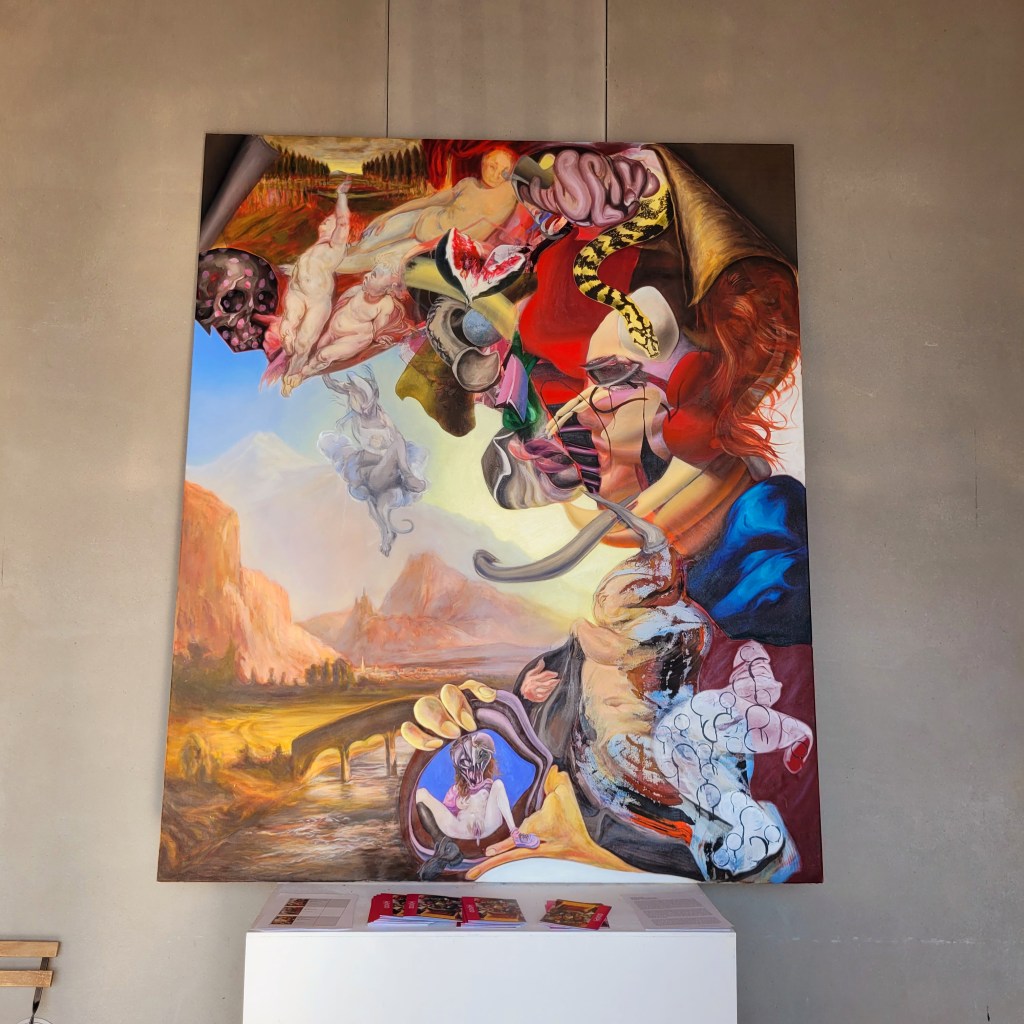
Five large canvases presented in symmetry… the moment has something solemn and miraculous… liturgical. The gallery becomes a nave… a sacred place. Wherever the gaze lands, the frenzy of shapes and colors draws the viewer into figurative landscapes where paradises mingle with sins. The smell of incense mixes with the scent of flowers, overripe fruit, sex and stormy rain. Temptation meanders between gluttony and lust. We find vanities (skulls, fruits, flowers, meat, butterflies, soap bubbles, etc.) dramatized… living-still-lifes… dreamlike landscapes (peaceful and tumultuous) and mutating figures (divine and monstrous). It is a state of pleasure and decadence… of intense duplicity. However, there is a form of revelation… of the last frontier… embodied by the curtain… red like the Passion. In the manner of Rembrandt, the curtain (the velum) helps to directly involve the viewer who becomes an actor in the pictorial fiction… discovering what is hidden behind (like the door to a tomb). The artist is a revealer of secrets, of something beyond, and makes the viewer complicit.


Existential metaphor, it is in this crash of the divinely mortal world that the spectator reveals his inner landscape… reveals his psychology, exhumed, to others as well as to himself… and regains a taste for life in all its ephemeral and thrilling splendor… Et Resurrexit a Mortuis.
More infos:
 ABSTRACT MIMESIS